What I Learned from the Chapters
Copies of Ryōanji all over the US: Chase Manhattan Bank, Japanese Embassy in DC, etc.
what exactly is zen?
rock gardens = an air of solitude = zen is nothing more than a stereotype
...but the Japanese people did not encourage him to leap right away into the world of zen. instead, they
named several of the "Japanese art associated with zen" and suggested that he study one of those as an
introduction to zen.
ikebana (flower arranging), sumie (ink painting), kyūdō
Herrigel learning kyūdō
draw the bow spiritually
he felt that he was not breathing but that he was being breathed I laughed at this line. sorry about
that...
the right art is purposeless, aimless. the more obstinately you try to learn how to shoot the arrow for the
sake of hitting the goal, the less you will succeed in the one and the further the other will recede.
"it shoots": "it" refers to something that transcends the self
it was only after WWII that kyūdō became strongly associated with zen
prior to that, most people practiced kyūdō for physical training or as a pastime
even today it is very unusual for a person in Japan to practice kyūdō as a form of zen training
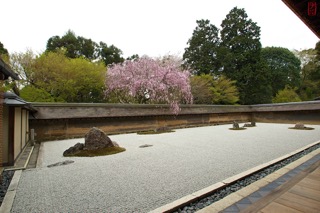
the Ryōanji rock garden
what did people in the Edo period think about the rock garden?
"it is called the garden of the Tiger Cubs Crossing the River" because of the placement of the rocks
Ryōanji was just a deserted temple rarely visited by anyone until 1950.
it did not even have a permanent chief priest.
Ryōanji changed a lot overtime.
Ryōanji became popular during the tenure of Matsukura, who was the chief priest.
Tamura praised the
beauty of the rock gardens as follows
The flat garden enclosed by an earthen wall is the height of simplicity and eloquently expresses the highest
refinement of the craft of Japanese stone arranging...
quite a few post-war middle-school textbooks teach about Ryōanji, could be a reason why it suddenly became
popular
Two questions about Ryōanji
1. who created it?
several theories:
- Sōami: painter
- Hosokawa Katsumoto: rock garden maker??
- Kanamori Sōwa: tea master; not as many people support this theory.
2. when did the view that rock garden = zen come to the fore? => history of Ryōanji
In 1588, Toyotomi Hideyoshi, the general who brought the Warring States period to an end, visited Ryōanji and
composed a poem for a weeping cherry tree.
(He composed poem for the tree instead of the garden itself. At that time, the garden is nothing to do with zen
whatsoever)
during the Meiji period the rock garden succumbed to the influence of hte anti-Buddhist sentiment of the times.
Shiga and Murō wrote about Ryōanji
people did not think Ryōanji was beautiful at all back then
after WWII, people began to associate Ryōanji with zen; at the same time, zen became popular; so did Ryōanji
Proof of Beauty
should we be able to prove, or at least rationally explain beauty?
That's a good question. To me, the answer is yes, because reasoning and expressions, verbal or non-verbal,
are also beauty themselves
equilibrium and dynamism - the interpretation of the rock garden according to constructivism can be summarized
in this way.
=> Saitō:
- Saitō can be considered the first person to see zen in Ryōanji: "embrace one in the great universe", "spirit
harmony", "vitality of movement"
- Saitō's reasoning: directional axes of the stone groupings (vertical, horizontal, oblique)
- "the overall dynamism of the groups of stones gives the garden a very ambitious appearance with a faint tinge
of lustful passion, bringing it to the edge of vulgarity"
=> Tanaka Sansetsu:
- weeping cherry tree
=> Shigemori Mirei:
- first person to explain the stone groupings using supplemental lines
=> Eyama:
- explain using a surveyor's diagram: symmetrical beauty can be explained by logarithmic rules
- Ryōanji was based on the sqrt(6) standards
- first person to examine the beauty using math principles
sounds pretty geeky, but I like his interpretation
- later, Eyama replaced his own theory with "golden ratio"
=> Ōyama Heishirō:
- if one looks at the garden while walking on the veranda in front of the abbot's quarters, only 14/15 stones
are visible at any time.
- stones are arranged like a fan opening around the center of the abbot's quarters.
- in reality, however, the 14/15 stone theory is wrong...
=> Ono Masa'aki:
- 15 shaku standard: almost all of the stone grouping in the garden are ensconced in a harmonious relationship
of a distance from one another of 15 shaku, half of that, or one third of that (with one exception)
=> Gerte J.Van Tonder:
- computer based calculation ("medial axis transformation"): visual axis of the rock garden passes through the
center of the abbot's quarters
Research which is considered science with its universal applicability really only becomes meaningful within
the historical dynamic.
huh...really? I don't feel like that's the case...